Unrivaled hybrid fuel efficiency and features
Ford Fusion Hybrid
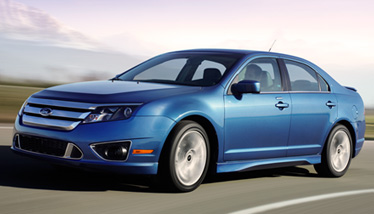
There’s a common misperception that U.S. automakers are behind some imports in technology and fuel efficiency. That may have been true some years ago, but it could not be further from the truth today. Both Ford and GM have become quality and fuel economy leaders in the last few years, especially from the highly competitive mid-size segment up. Chrysler still trails in both but is working hard and fast to catch up. Don’t believe us? Check the numbers.
And while it is true that Japanese automakers Honda and Toyota saw the potential of gasoline-electric "hybrid" technology earlier, invested heavily in it sooner and brought it to market first, it is also true that the top two U.S. makers have assumed hybrid fuel-efficiency leadership as of 2009 with their own state-of-the art technology. While GM is offering fairly affordable mild hybrid sedans and more expensive, high tech 2-Mode hybrid SUVs and trucks, Ford has redesigned its already excellent parallel hybrid system— and is expanding its availability to the substantially upgraded 2010 Ford Fusion and Mercury Milan midsize hybrid sedans.
The EPA estimates for these ultra-fine new Fusion and Milan Hybrids are an impressive 41 mpg city and 36 highway, which beats Toyota’s ’09 mid-size Camry Hybrid by eight and two mpg, respectively. They are, Ford says, the most fuel-efficient midsize sedans in America.
Design and Features
The conventional Fusion and Milan, nicely
restyled and much improved for 2010, offer the mid-size segment’s best
gasoline four-cylinder fuel economy, more powerful available V-6s,
class-exclusive technologies—including blind spot detection and warning
with cross traffic alert and Ford SYNC®—and
more total passenger and luggage capacity than the Camry. The Fusion’s
new look is sportier, more upscale and aerodynamically slicker. The new
front end sports large, wrap-around headlamps, a refined three-bar
grille over an aggressive lower air intake, a power-dome hood, and new
aerodynamic underbody shields to further boost its fuel economy. Around
back, more integrated tail lamps contribute to a smoother, more
appealing look.
The interior design is more technical and contemporary, with new metallic trim finishes on the instrument panel, center console, doors and steering wheel. A new instrument panel offers soft upper and lower skins—less hard plastic than typical Japanese sedans—and cool ice-blue lighting. The gauges have daytime backlighting and 3-D elements simulating the high tech, jewel-like look of a fine watch. And we love the new leather-wrapped steering wheel, with form-fitting "palm swells," and the very comfy new seats, with improved contours, more side support, smoother side bolsters and either textural or leather inserts with contrasting stitching.
All-New Hybrid
But the most exciting news is this all-new
Fusion Hybrid. Together with its Mercury Milan Hybrid counterpart, it
joins the Ford Escape and Mercury Mariner (compact SUV) Hybrids to
double both the size and volume of Ford Motor Co.’s hybrid lineup. The
Ford Hybrid team has developed a powertrain system that combines the
best attributes of the gasoline engine and electric battery-driven
motors," Ford engineers assert, "to deliver optimal driving performance
and fuel economy," Driving a Fusion Hybrid on city streets and in urban
freeway traffic near Ford’s Dearborn, MI Product Development Center on
a bitter cold winter afternoon, we were impressed by its efficiency
"coaching"
system, which Ford calls SmartGauge™ with EcoGuide, and by how
seamlessly and transparently it transitioned from gas to electric
power, and back. We achieved an average of 38.4 mpg driving normally
with traffic and 48.6 mpg very slowly, feather-footing our way along
while ignoring irritated drivers
behind.
Among this next-generation system’s key features are an ultra-efficient new 2.5-liter four-cylinder "Atkinson cycle" engine good for 155 hp and 136 lb.-ft. of torque mated to an electronically-controlled continuously variable transmission, or "e-CVT." Intake Variable Cam Timing (iVCT), enable seamless transitions from gas to electric and vice-versa, while both spark and cam timing are varied according to engine load to optimize efficiency and emissions. Enhanced electronic throttle control reduces airflow on shutdowns, which reduces fuel need on restarts, and a "wide-band lambda sensor" analyzes air-fuel ratios and adjusts the lean/rich mixture to keep the system in balance and minimize emissions.
The new 275-volt nickel-metal hydride (NiMH) battery is smaller, lighter and optimized to produce 20 percent more power. Cooled by cabin air, its improved chemistry allows it to run at higher temperatures, and an added variable voltage converter boosts voltage to the battery to operate the motor and generator more efficiently. A "smarter" climate control system with an electric air-conditioning compressor minimizes engine usage by running it only as needed for heating and cooling.
The brake system delivers full regenerative braking (when the drive motor becomes a generator), backed up by friction braking as needed, to capture nearly 94 percent of the energy normally lost through friction in braking and send it back to the battery. And, as we noticed during our drive, it delivers much better brake pedal feel compared to the previous system.
The hybrid system also allows the Fusion and Milan Hybrids to operate longer at higher speeds in electric mode than competitive systems. They can run up to 47 mph in pure electric mode, approximately double the speed of some competitors. "Because our hybrid can run at a much higher speed in electric mode, you can do so much more in city-driving situations," says Ford Hybrid Applications Manager Gil Portalatin. "Under the right conditions, you can drive in your neighborhood or in mall parking lots without using a drop of gasoline.' With the 41 city and 36 hwy ratings, Fusion and Milan Hybrids can achieve a driving range of over 700 miles on a single tank of gas.
The bottom line of all this advanced technology is a very "normal" driving experience requiring little sacrifice in exchange for superior fuel efficiency vs. Toyota’s Synergy Drive or anyone else’s similar system. And then there’s Ford’s SmartGauge™ with EcoGuide, which cleverly coaches drivers on how to optimize their hybrid’s efficiency performance.
It uses two high-resolution, full-color liquid crystal display (LCD) screens flanking the speedometer that can be configured to show different levels of information. The approach is multi-layered: A tutorial mode helps drivers learn about the system and its instruments, while tech enthusiasts will enjoy detailed gauges that help them become more efficient. The system even "grows" leaves and vines on-screen to reward efficient driving.
Drivers can choose one of four data screens: The basic "Inform" screen displays fuel level and battery charge status; "Enlighten" adds an electric vehicle mode indicator and a tachometer; "Engage" adds engine output power and battery output power; and "Empower" adds power to wheels, EV power threshold and accessory power consumption. All levels can show instant fuel economy, fuel economy history, odometer, engine coolant temperature, transmission gear and trip data—trip fuel economy, time elapsed fuel economy and miles to empty. There’s even an engine coolant temperature indicator that turns green when the engine is warm enough to allow engine shut-off and restart for full EV operation.
The 2010 Fusion Hybrid is differentiated from conventional models by "road and leaf" hybrid badging on the sides and rear, eco-friendly seat fabric made from post-industrial 85-percent recycled materials, a standard 110-volt power outlet and unique 17-inch, 15-spoke wheels. Anyone considering investing in a mid-size hybrid sedan should give this one a serious look and an extended drive. It should arrive in Ford dealer showrooms by spring 2009.
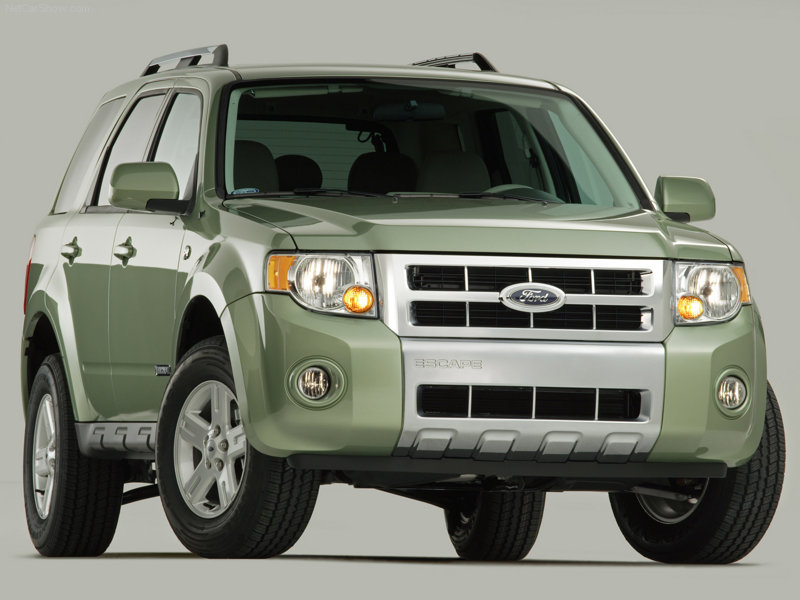
Ford Escape Hybrid
Hybrid Efficiency
According to U.S. government tests, front-wheel-drive versions of the 2009 Ford Escape Hybrid get an impressive 34 miles per gallon in city driving and a very respectable 31 mpg on the highway. The all-wheel-drive Escape Hybrid gets 29 mpg city and 27 on the EPA highway cycle. In addition, the Escape Hybrid earns California's Advanced Technology Partial Zero Emissions Vehicle (AT-PZEV) status, the cleanest emissions rating achievable by a vehicle with a petroleum-burning engine.
While a conventional vehicle gets its best fuel mileage during steady, lower-speed highway cruising, a hybrid's major fuel savings occurs by avoiding idling, since you're getting zero miles per gallon when sitting still with the engine running. When at a stoplight, stuck in traffic or coasting down a long grade, the Escape Hybrid computer turns the engine off. At that time, the battery provides power for the radio, electrically driven power steering, and to restart the engine.
The '09 Escape Hybrid gets an Atkinson-cycle version of the new 2.5-liter inline four-cylinder gasoline engine that is standard in gasoline-engine-only Escape. An Atkinson-cycle engine is more fuel efficient than a conventional engine. In the Escape Hybrid, the 2.5-liter four-cylinder makes 153 horsepower and a peak of 136 pound-feet of torque.
The combination of the Escape Hybrid 94-kilowatt electric motor and gasoline engine produces acceleration to rival its V6-engined sibling. Considering the V6 makes an impressive 240-horsepower, that's more than adequate to allow easy merging into a fast-moving freeway. Steep off-pavement trails will also be easily conquered.
This engine has a redesigned computer that smoothes the transition from gasolinepowered to electric-only operation. Other improvements reduce powertrain vibrations that were noticeable in last year's vehicle. The Escape Hybrid comes with an electronic continuously variable transmission (eCVT). An eCVT better keeps the gasoline engine in its most efficient operating range.
The 2009 Escape Hybrid also features a revised regenerative braking system. When you need to slow down or stop, this system captures some of the energy that was used to get the vehicle up to speed and would otherwise just be turned to heat by the brakes. In essence, it turns the electric motor into a generator and recharges the battery.
The Escape Hybrid 330-volt nickel-metal-hydride batteries are warranted for eight years or 100,000-miles in most states and 10 years or 150,000 miles in states that follow California standards (see your dealer for limited warranty details).
To help the Escape Hybrid go further on each gallon of gas, Michelin developed a new version of its Latitude Tour. This tire has lower rolling resistance, which means it takes less power—and thus less gas—to make the tire rotate.
Vehicle Dynamics and Proven Safety
In addition to the new gasoline engine for the gasoline-only powered Escape, major changes for the 2009 Escape Hybrid include restyled nose and hood, a capless refueling system, re-tuned suspension for better ride comfort and an enhanced braking system that improves initial performance during an urgent stop. Also new: The Escape Hybrid seat cushions are made with a soy-based foam rather than the conventional petroleum-derived product. Seat fabrics are made from 100 percent post-industrial materials. Leather seating surfaces are also optional. Cruise control now comes standard on all Escapes. The Escape Hybrid features a rear seat back that folds forward in a 60/40 split to enhance cargo room.
Escape Hybrid standard features include anti-lock brakes and Ford AdvanceTrac® electronic stability control: Combined, they help the driver maintain control during accident avoidance maneuvers. The Escape Hybrid has six airbags, including a pair of two-row side-curtain airbags. The Ford Personal Safety System® is also standard on all 2009 Escape and Escape Hybrid models. In addition to the dual-stage driver and front-passenger airbags, the system includes both driver and passenger seat position sensors, and load-limiting safety belt retractors and pretensioners.
These technologies work in concert for front airbag deployment depending on the driver's seat location, passenger weight and safety belt use. They also helped the 2009 Escape earn 5-star crash-test honors from the National Highway Safety Administration (NHTSA) and the Insurance Institute for Highway Safety's (IIHS) Top Safety Pick award.
The standard sound system includes a single-disc CD player, four speakers and an MP3 audio jack. Available is a system that has a six-disc CD player, 320 watts of power and seven speakers. All Escape models are satellite-radio capable, and the Hybrid and Hybrid Limited come with a six-month subscription to SIRIUS® satellite radio. Standard on Escape gas Limited and all Escape Hybrid models is SYNC, the voice-activation system for mobile phones, MP3 players and sound systems that was developed by Ford and Microsoft.
The Escape Hybrid is available in two trim levels: Escape Hybrid and new this model year the fully equipped Escape Hybrid Limited. Front-wheel drive is standard, while all-wheel drive is available. Pricing starts just above $29,730 for the front-wheeldrive Escape Hybrid while a fully loaded all-wheel-drive Escape Hybrid Limited can exceed $35,000. The 2009 Ford Escape Hybrid proves an SUV can get great fuel mileage while helping keep the air clean.
